We are pleased to announce that one paper from our lab has been accepted and published at IEEE ICASSP 2026 (International Conference on Acoustics, Speech and Signal Processing), one of the premier international conferences in speech and signal processing, held in Barcelona, Spain, on May 4–8, 2026.
The paper, titled “PhoenixDSR: Phoneme-Guided and LLM-Enhanced Dysarthric Speech Recognition,” is authored by Yuxuan Wu, Yifan Xu, Junkun Wang, Xin Zhao, Jiayong Jiang, and Zhaojie Luo. It is a joint work of the State Key Laboratory of Digital Medical Engineering and the School of Biological Science & Medical Engineering, Southeast University, together with the Shenzhen Loop Area Institute. The corresponding author is Zhaojie Luo.
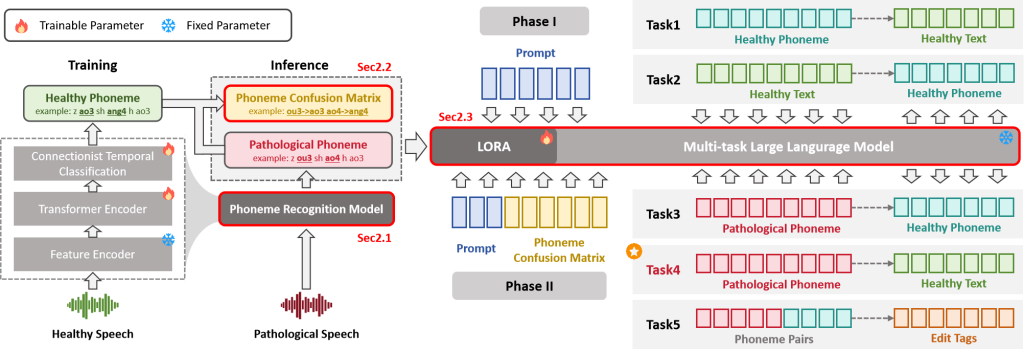
Abstract: Automatic speech recognition (ASR) still struggles on dysarthric speech due to data scarcity and speaker heterogeneity. We present PhoenixDSR, a phoneme-mediated framework that decouples acoustic variability from linguistic decoding. A Wav2Vec2-CTC recognizer trained on healthy speech provides stable, interpretable phoneme sequences. From limited dysarthric alignments, we estimate a weighted confusion probability matrix that fuses global and speaker-specific patterns. A lightweight LLM decoder is then trained on five tasks—bidirectional text–phoneme mapping, dysarthric-to-healthy normalization, phoneme-to-text decoding, and edit-operation prediction—to enable context-driven repair of systematic phoneme errors. On the public CDSD corpus, PhoenixDSR attains 18.3% CER and 13.7% PER, outperforming end-to-end fine-tuning and LLM post-editing; ablations confirm the importance of phonotactic pretraining and confusion priors. Few-shot personalization updates only the prior, yielding additional gains without further gradient training. By combining interpretable phoneme-level priors with context-aware decoding, PhoenixDSR achieves data-efficient and robust recognition.