On May 30, 2026, the 2026 Changzhou “Hua Luogeng Cup” Innovation and Entrepreneurship Competition and the 7th Jiangsu Provincial College Students’ Biomedical Engineering Innovation Design Competition came to a successful conclusion at the Renaissance Changzhou Hotel. As an important component of the Changzhou “Hua Luogeng Cup” Innovation and Entrepreneurship Competition, this year’s event showcased the innovative vitality and practical achievements of students from Jiangsu universities in the field of biomedical engineering, injecting fresh momentum into disciplinary development and industry-education integration.
This year’s competition was jointly hosted by the Jiangsu Society of Biomedical Engineering, Southeast University, the Changzhou Municipal Science and Technology Bureau, the Changzhou Municipal Human Resources and Social Security Bureau, and the Changzhou Association for Science and Technology, with guidance from the Jiangsu Higher Education Association and the Talent Office of the Changzhou Municipal Party Committee. The competition continued to uphold its core philosophy of “applying knowledge in practice, integrating industry and academia, and promoting learning through competition,” focusing on innovative practice in the healthcare field and providing an important platform for college students across the province to showcase their innovative achievements in biomedical engineering.
This year’s competition attracted 371 teams from 23 universities across the province, with participation remaining at a consistently high level. The entries spanned the Designated Project Group, the Open Project Group, and the Science Popularization Works Group, and a Career Planning track was established for the first time. After rigorous evaluation by the expert panel, 90 teams stood out and advanced to the finals, where they competed fiercely in Changzhou on May 30.
Southeast University’s HAI Lab won two First Prizes in this competition: the project “Healing Echo — A Voice Assistance System for Laryngectomees and People with Dysarthria” won First Prize in the Artificial Intelligence Group, and the work “Resonant Echo — A Medical Interpretation of Dysarthria” won First Prize in the Science Popularization Video category.
“Healing Echo — A Voice Assistance System for Laryngectomees and People with Dysarthria” addresses the real communication needs of laryngectomy patients and people with dysarthria. By integrating technologies such as AI speech recognition, semantic error correction, and personalized speech synthesis, it explores the application value of intelligent voice assistance systems in medical rehabilitation and everyday communication scenarios. The science popularization video “Resonant Echo — A Medical Interpretation of Dysarthria” presents medical knowledge about dysarthria in accessible terms, helping the public better understand the communication difficulties and rehabilitation needs faced by people with speech disorders.
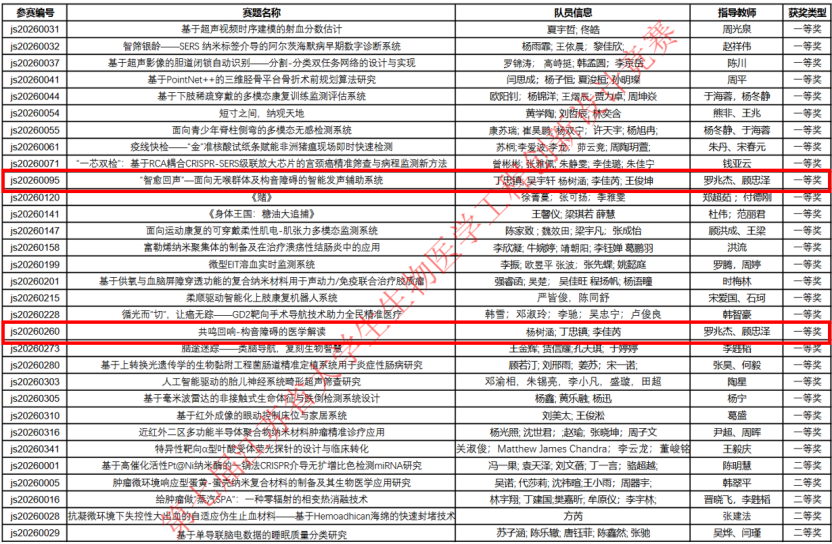
These awards reflect HAI Lab’s ongoing exploration in the areas of intelligent health, human-computer interaction, and medical assistive technology, and also demonstrate the lab’s interim achievements in conducting interdisciplinary innovation grounded in real clinical needs. Going forward, the lab will continue to focus on integrating medical needs with artificial intelligence technology, advancing the translation of relevant research outcomes into real-world application scenarios.